
Today we’re releasing Indra OCR 1.2. It still runs on a CPU with no GPU, and now it reads math as LaTeX by default and handles tables much better.
On OmniParseBench, the headline goes from 71.4 for 1.1.2 to 78.9:
| release | headline | text | tables | layout |
|---|---|---|---|---|
| 1.1.2 | 71.4 | 62.6 | 59.6 | 92.1 |
| 1.2 | 78.9 | 68.0 | 75.9 | 92.7 |
1.2, --no-math | 71.6 | 45.7 | 76.0 | 93.0 |
All scores come from OmniParseBench’s own harness and scorer (omni-parse-bench 1.7.0), on all 2,937 pages and 16,288 tests, with default settings. The --no-math row still counts the math tests.
Most of the gain is in tables (+16.3) and text (+5.4).
What’s new
- Math on by default. Formulas come out as LaTeX, inline and on their own lines. Use
--no-mathorload(math=False)to skip the math models and their download. - Much better tables. Indra OCR now finds rows, columns, header cells and section rows, and writes them as HTML. It also rejects charts and blocks of prose that look like tables.
- Word boxes.
--format json --wordsorload(words=True)gives every word its own box. - Turned pages. When Indra OCR isn’t sure which way a page is turned, it reads lines both ways and keeps the reading that makes sense. You can also pass a page’s rotation if you know it.
- Digital PDFs. Better handling of broken font maps, symbol fonts and spaced superscripts in a PDF’s text layer.
How Indra OCR 1.2 compares
78.9 is the highest score of any CPU system we know of on the benchmark, and it matches or beats several open vision-language models that are built to run on a GPU and are 60 to 200 times larger:
| Model | Parameters | Built for | OmniParseBench |
|---|---|---|---|
| Indra OCR 1.2 | about 17M | CPU | 78.9 |
| PaddleOCR-VL-1.6 | 0.96B | GPU | 78.7 |
| Infinity-Parser2-Flash | 2.2B | GPU | 78.4 |
| DeepSeek-OCR-2 | 3.4B | GPU | 75.2 |
| HunyuanOCR-1.5 | 1.0B | GPU | 64.6 |
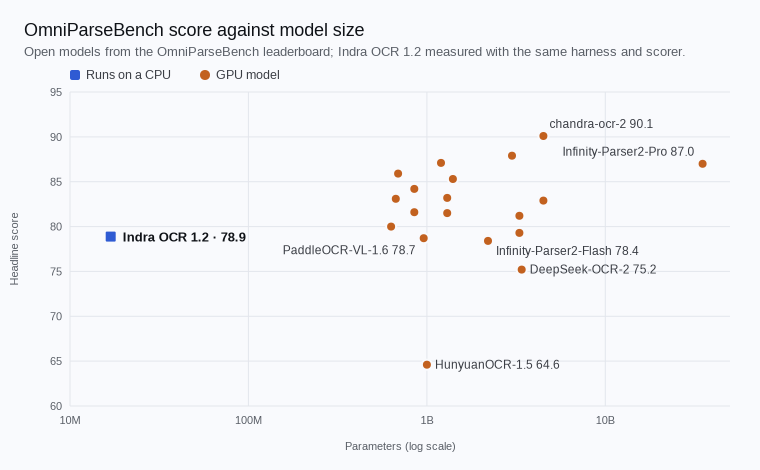
The larger GPU models still lead overall: the best open model on the leaderboard, chandra-ocr-2, scores 90.1. Indra OCR is built for a different budget, about a second per page on one CPU core, with no GPU.
Against other software that runs on a CPU, the gap is wide. These engines ran on the same pages with the same scorer, in an earlier version of the benchmark (scorer 1.0.0rc1). Indra OCR 1.2 scores 78.8 on that version:
| Engine (CPU) | OmniParseBench | Text | Tables | Layout |
|---|---|---|---|---|
| Indra OCR 1.2 | 78.8 | 68.0 | 75.7 | 92.6 |
| PaddleOCR PP-StructureV3 | 58.4 | 55.6 | 47.8 | 71.7 |
| PaddleOCR PP-OCRv6 small, text only | - | 35.8 | 0 | - |
| Tesseract 5 | - | 19.3 | 0 | - |
Tesseract and the PP-OCR text models write lines, not tables or layout blocks, so they get no headline score. PP-StructureV3 is PaddleOCR’s full document pipeline; its row leaves out 19 pages where it stalled.
What the output looks like
These are real Indra OCR 1.2 outputs on benchmark pages, with default settings. The boxes are drawn from the JSON output with no edits: colored boxes are layout blocks with their label, faint blue boxes are lines.
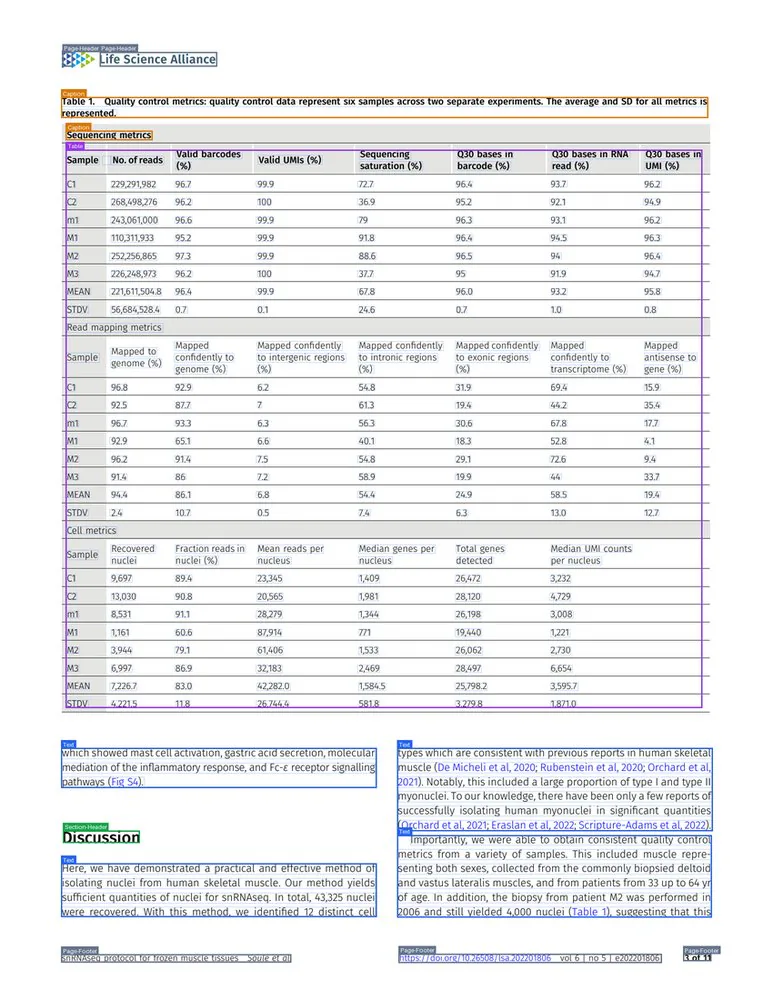
The table comes out as HTML, with the header row and every number in its own cell:
<tr>
  <th>Sample</th>
  <th>No. of reads</th>
  <th>Valid barcodes (%)</th>
  <th>Valid UMIs (%)</th>
  ...
</tr>
<tr>
  <td>C1</td>
  <td>229,291,982</td>
  <td>96.7</td>
  <td>99.9</td>
  <td>72.7</td>
  <td>96.4</td>
  <td>93.7</td>
  <td>96.2</td>
</tr>
<tr>
  <td>C2</td>
  <td>268,498,276</td>
  <td>96.2</td>
  <td>100</td>
  <td>36.9</td>
  <td>95.2</td>
  <td>92.1</td>
  <td>94.9</td>
</tr>
Source: Soule et al., Life Science Alliance (2023), CC BY 4.0.
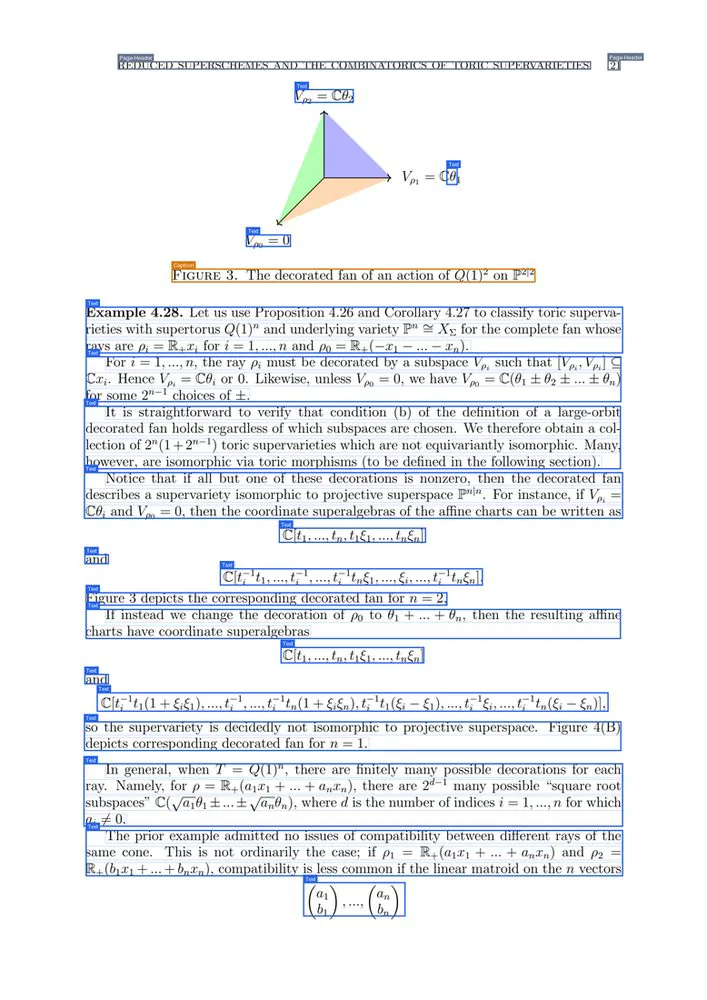
For $i = 1 , . . . , n ,$ the ray $\rho _ { i }$ must be decorated by a subspace $V _ { \rho _ { i } }$
such that $[ V _ { \rho _ { i } } , V _ { \rho _ { i } } ] subseteq$ $mathbb { C } x _ { i }$ ...
Source: Reduced superschemes and the combinatorics of toric supervarieties, arXiv 2502.15977 (2025), page 21, CC BY 4.0.
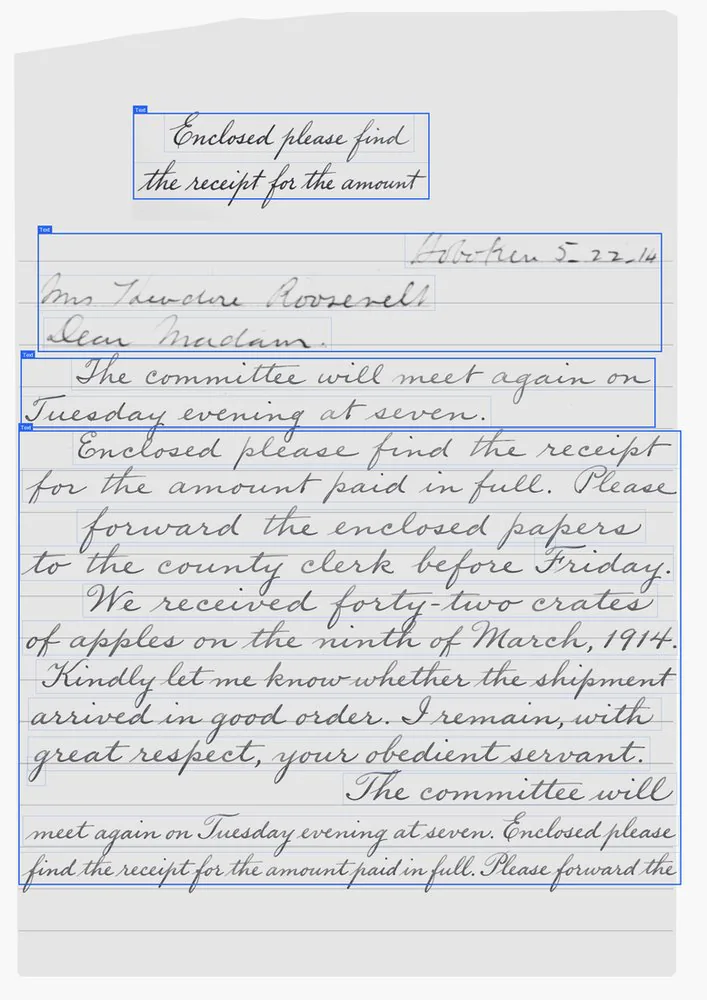
The body of the letter reads cleanly: “Enclosed please find the receipt for the amount paid in full. Please forward the enclosed papers to the county clerk before Friday. We received forty-two crates of apples on the ninth of March, 1914.” The address lines at the top are harder and come out with errors (“Sean Madam” for “Dear Madam”).
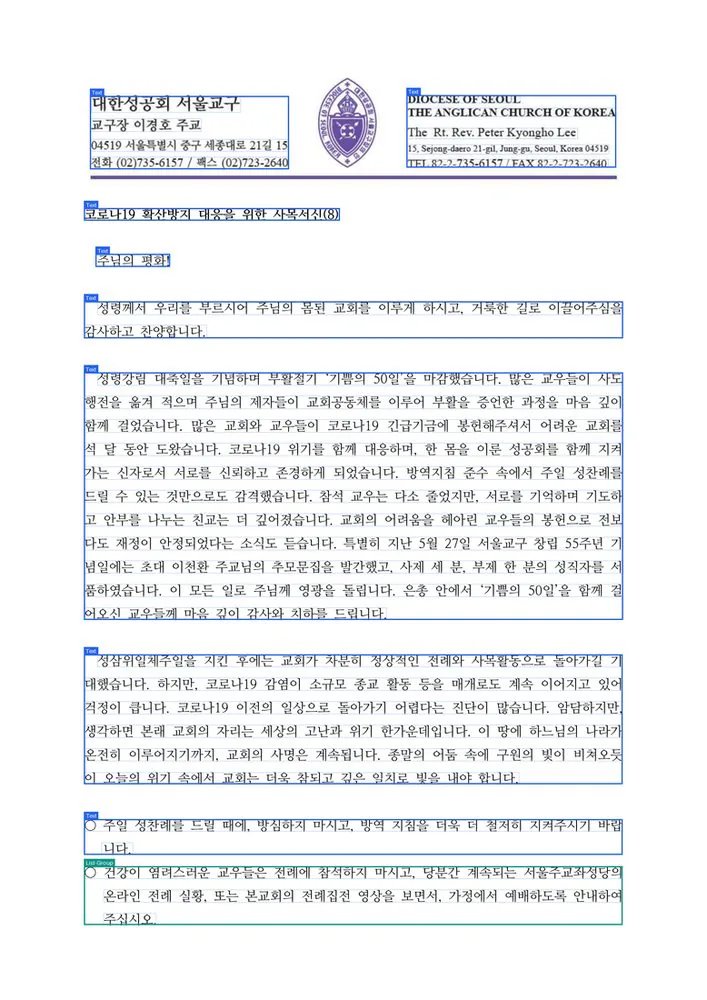
Each line goes to the recognizer for its script, so the Korean body and the English letterhead are both read: “코로나19 확산방지 대응을 위한 사목서신(8)”, “DIOCESE OF SEOUL THE ANGLICAN CHURCH OF KOREA”.
Speed
On one 34-core AMD EPYC server, with one single-threaded worker per core and the same 300 benchmark pages, Indra OCR 1.2 reads 20.8 pages per second on 32 cores with its default settings, and 25.8 with math off. That is about 1 second of CPU time per page, or about 48 ms per page across the 32 cores. It is also about 7x the speed of Tesseract 5, which read 2.92 pages per second on 32 cores in our first Indra OCR post, on a faster machine of the same type. The new features cost some speed: version 1.1 read 30.1 pages per second on the same machine. Most of the extra time is the math reader, which these math-heavy pages exercise often (about 0.15 seconds a page). With math off, 1.2 runs at 86 to 92% of 1.1’s speed, and the difference is mainly the new table structure model.
License
The code is Apache 2.0, and the model weights use a modified OpenRAIL-M license: free for research, personal use, and startups under $5M in funding or revenue, and not for use that competes with our API. For broader commercial use, see our pricing.
Try it
pip install -U indra-ocr
indra-ocr paper.pdf                       # markdown, math as LaTeX
indra-ocr scan.png --format json --words  # lines, blocks and word boxes
indra-ocr-viewer                          # see lines, blocks and reading order on the page
The code is on GitHub, and the models are on Hugging Face.
For handwriting, complex tables and degraded scans at the highest accuracy, Chandra on Datalab is the better fit.