# How Davis County School District brings STEM to braille with Chandra
> How a certified braille transcriber at one of Utah's largest school districts uses Chandra to turn math and science documents into braille-ready markdown and LaTeX, cutting quality-control time by roughly 90%.
- Canonical: https://www.datalab.to/blog/davis-county-datalab-casestudy
- Published: 2026-09-04
- Authors: Datalab Team
Ryan Hunsaker is a Teacher for Students with Visual Impairments at Davis School District, one of Utah's largest school districts. He teaches blind and low-vision students the skills to succeed in school, such as braille reading and writing, abacus, and screen readers. His role also includes a unique task: producing the materials to teach his students. As a certified braille transcriber, he creates Unified English Braille transcriptions, UEB and Nemeth math codes, music braille, and tactile graphics, among other formats.
## The district's go-to for STEM transcription
A few years ago, Ryan became the go-to person in his district for STEM transcription. Two things drive the urgency. Students move into the district mid-year needing math materials, and the state agency's queue can't produce them in time. District-generated math and science curriculum also often isn't available until well after state submission deadlines.
Today, he supports about 120 students per year. Of those, the hardest STEM work is concentrated among 10-15 students. One 500-page textbook can equal 1,500-1,600 pages of braille.
> "I have a legal obligation of a zero turn-away policy. It just has to happen." — Ryan Hunsaker, Teacher for Students with Visual Impairments, Davis School District
Recently, a longtime colleague who handled English and social studies transcription retired, meaning even more of that load shifted onto him.
## The challenge: OCR that preserves the math
Given looming deadlines and a large document backlog every year, OCR is pivotal to getting the transcriptions completed before the school year starts. His pipeline is designed to minimize time in quality control by feeding markdown with inline LaTeX into pandoc and on to his braille tools.
For years, he struggled to find a tool that would both recognize math and preserve reading order. MathPix would scramble reading order by skipping three to five paragraphs, then dropping them back in and auto-renumbering lists so he couldn't track where they went. It buried matrices as tables of values between two brace images, and skipped some equations entirely by treating them as pictures.
He also tried Adobe Acrobat, but found that it introduced a stream of 1-for-L, 3-for-E, and 3-for-B character errors with no equation fidelity.
His search was constrained by privacy, too. For certain textbook and assessment publishers, he's legally required to destroy the hard copy and confirm in writing that he's never uploaded it anywhere. Teacher-created materials and student information were required to be confidential. His privacy requirements ruled out any non-local tools.
> "If I could not prove that nothing was left on the remote server, I was out of luck." — Ryan Hunsaker
## The solution: Chandra
Ryan's background in academic neuroscience brings a helpful philosophy: automate the bulk of repetitive work, then fix predictable mistakes.
> "My goal now for any labor-intensive task is to find the way to make a computer do the majority of the time-intensive work to 90%+ accuracy/fidelity, and I go in afterward and do quality control to reach the 100% value that is required by the nature of my work. I feel strongly I need the 90% because if it is much lower, I spend too much time evaluating problems and I lose the time benefits." — Ryan Hunsaker
He initially found [Marker](https://github.com/datalab-to/marker) during a GitHub search for "math to LaTeX" and "Math OCR." Later, he discovered [Chandra](https://github.com/datalab-to/chandra) almost by accident; it came up when he went to reinstall Marker after accidentally wiping his computer.
Compared to the previous tools he tested, Marker was a significant improvement; it gave predictable output and the correct reading order. Chandra took it one step further by improving image and equation handling and markdown cleanliness. Chandra also did not use spell-check to fix typos in extraction. This is important in preserving misspellings in original documents — a requirement for any materials given to students.
> "I put an old document up in the pipeline generation on datalab.to and it gave me a 95% correct output. I realized how much time this would save me." — Ryan Hunsaker
## The results
Roughly 1,800 pages of math and science recently landed on his desk, and Chandra handled the batch without incident. The reading order was preserved accurately. As a bonus, it pulled clean text out of tricky areas that were hard to detect with his own eye.
A handwritten biology worksheet parsed by Chandra, side by side with the original
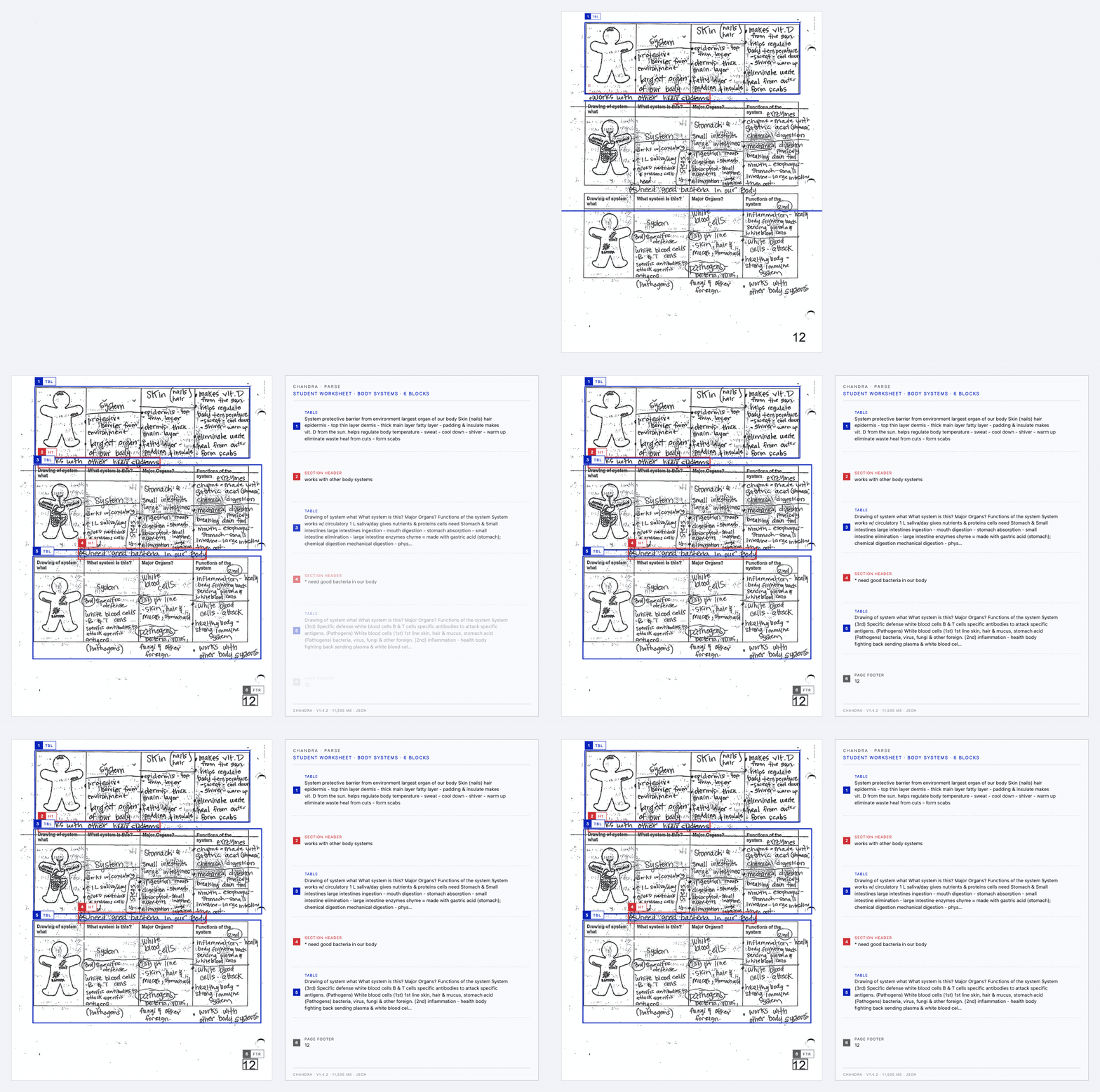 There were rare gaps in OCR output, but they worked in his favor. What came back as errors were actually omissions due to a lack of source material, and the model did not make a guess.
On a per-document basis, measured against a five-page systems-of-equations worksheet, Chandra saves roughly 20 minutes versus MathPix, 45 minutes versus Adobe Acrobat, and 55 minutes versus MathKicker-AI. Across a full document, the compounding is dramatic:
> "When I was having to spend an hour fixing the file before I could pull it into my braille program, I can now spend 5 to 10 minutes just to sanity-check the OCR. It saves me literally hours a day when dealing with math and science." — Ryan Hunsaker
Because Chandra runs entirely on his own hardware, the privacy problem simply disappears, as there's no remote server to account for. For the material he does route through [datalab.to](https://www.datalab.to), Datalab's SOC 2 Type 2 report is available to support his district's review.
The change he keeps coming back to, though, isn't a number.
> "I can have a lot more confidence that when I submit a folder of files, it'll get OCR'd in a way that won't give me more work. The confidence is a massive stress reduction." — Ryan Hunsaker
Or, as he puts it to his colleagues: the fun part of the job — getting real math and science into students' hands, on time — now starts hours sooner.
There were rare gaps in OCR output, but they worked in his favor. What came back as errors were actually omissions due to a lack of source material, and the model did not make a guess.
On a per-document basis, measured against a five-page systems-of-equations worksheet, Chandra saves roughly 20 minutes versus MathPix, 45 minutes versus Adobe Acrobat, and 55 minutes versus MathKicker-AI. Across a full document, the compounding is dramatic:
> "When I was having to spend an hour fixing the file before I could pull it into my braille program, I can now spend 5 to 10 minutes just to sanity-check the OCR. It saves me literally hours a day when dealing with math and science." — Ryan Hunsaker
Because Chandra runs entirely on his own hardware, the privacy problem simply disappears, as there's no remote server to account for. For the material he does route through [datalab.to](https://www.datalab.to), Datalab's SOC 2 Type 2 report is available to support his district's review.
The change he keeps coming back to, though, isn't a number.
> "I can have a lot more confidence that when I submit a folder of files, it'll get OCR'd in a way that won't give me more work. The confidence is a massive stress reduction." — Ryan Hunsaker
Or, as he puts it to his colleagues: the fun part of the job — getting real math and science into students' hands, on time — now starts hours sooner.