 Talk to Sales
 Benchmarks
View scores and output across OCR models spanning many document categories.
Want to run these evals on your own documents?
Talk to Sales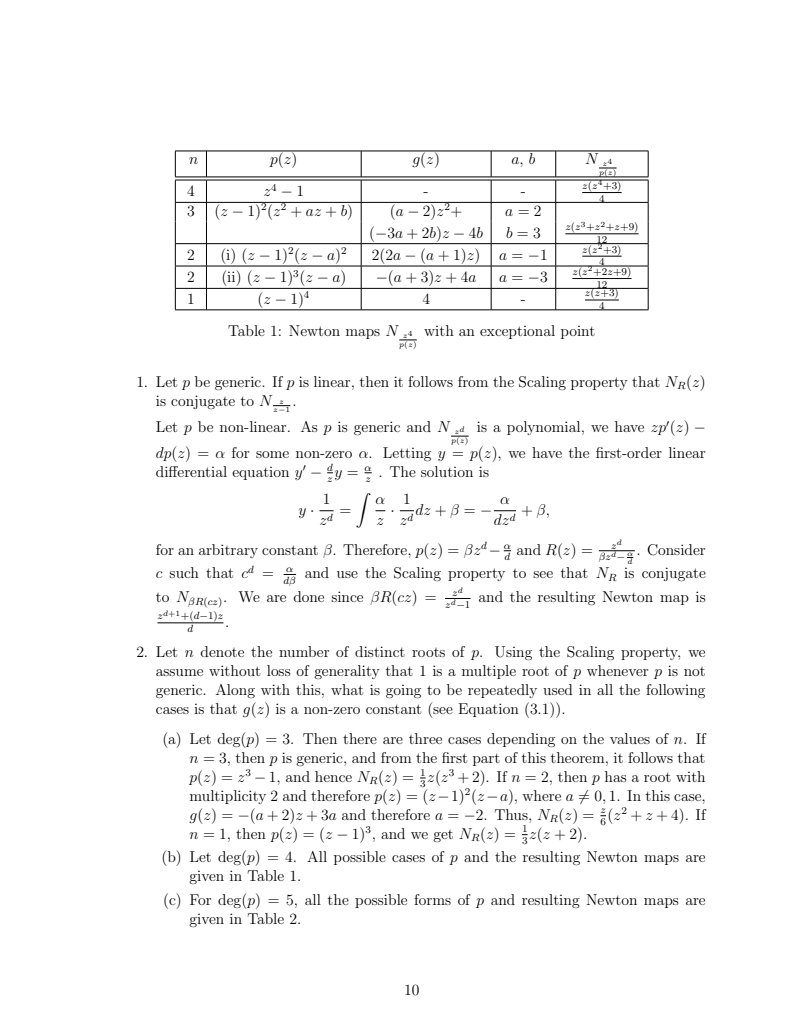
| 4 | - | - | ||
| 3 |
|
|||
| 2 | (i) | |||
| 2 | (ii) | |||
| 1 | 4 | - |
Table 1: Newton maps with an exceptional point
1. Let be generic. If is linear, then it follows from the Scaling property that is conjugate to .
Let be non-linear. As is generic and is a polynomial, we have for some non-zero . Letting , we have the first-order linear differential equation . The solution is
for an arbitrary constant . Therefore, and . Consider such that and use the Scaling property to see that is conjugate to . We are done since and the resulting Newton map is .
2. Let denote the number of distinct roots of . Using the Scaling property, we assume without loss of generality that 1 is a multiple root of whenever is not generic. Along with this, what is going to be repeatedly used in all the following cases is that is a non-zero constant (see Equation (3.1)).
(a) Let . Then there are three cases depending on the values of . If , then is generic, and from the first part of this theorem, it follows that , and hence . If , then has a root with multiplicity 2 and therefore , where . In this case, and therefore . Thus, . If , then , and we get .
(b) Let . All possible cases of and the resulting Newton maps are given in Table 1.
(c) For , all the possible forms of and resulting Newton maps are given in Table 2.
10