 Talk to Sales
 Benchmarks
View scores and output across OCR models spanning many document categories.
Want to run these evals on your own documents?
Talk to Sales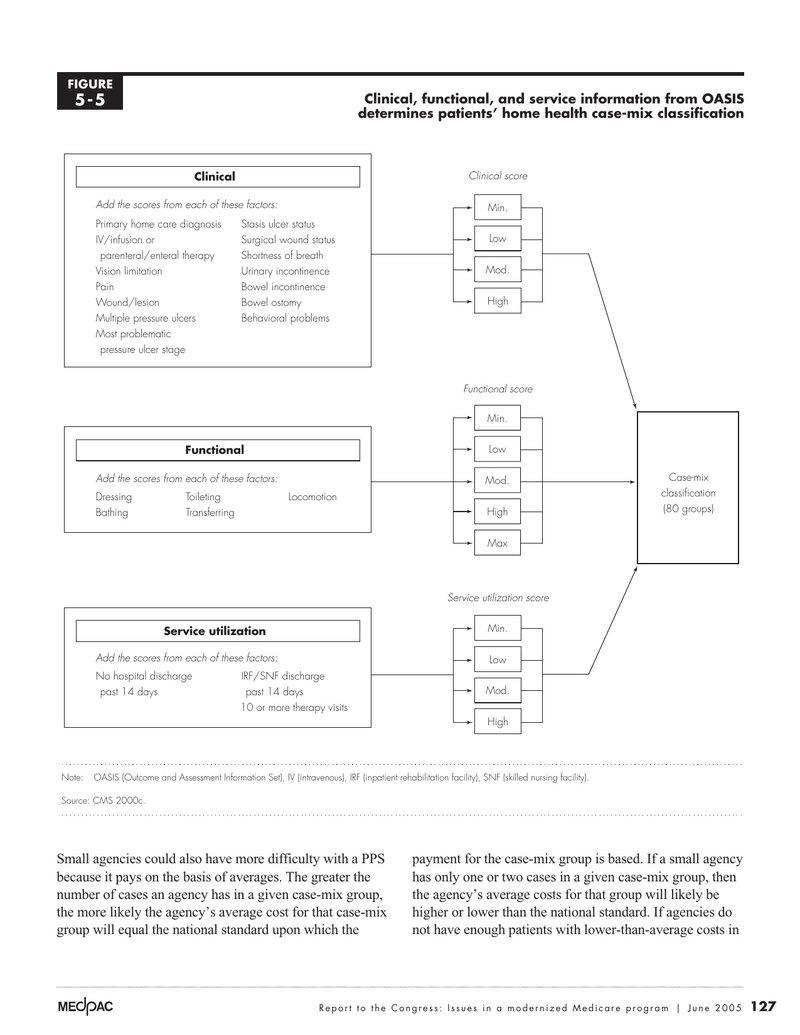
FIGURE
5-5
Clinical, functional, and service information from OASIS determines patients' home health case-mix classification

Clinical
Add the scores from each of these factors:
| Primary home care diagnosis | Stasis ulcer status |
|
IV/infusion or
parenteral/enteral therapy |
Surgical wound status |
| Vision limitation | Shortness of breath |
| Pain | Urinary incontinence |
| Wound/lesion | Bowel incontinence |
| Multiple pressure ulcers | Bowel ostomy |
|
Most problematic
pressure ulcer stage |
Behavioral problems |
Clinical score
Min.
Low
Mod.
High
Functional
Add the scores from each of these factors:
| Dressing | Toileting | Locomotion |
| Bathing | Transferring |
Functional score
Min.
Low
Mod.
High
Max
Service utilization
Add the scores from each of these factors:
|
No hospital discharge
past 14 days |
IRF/SNF discharge
past 14 days |
| 10 or more therapy visits |
Service utilization score
Min.
Low
Mod.
High
Case-mix classification (80 groups)
Note: OASIS (Outcome and Assessment Information Set), IV (intravenous), IRF (inpatient rehabilitation facility), SNF (skilled nursing facility).
Source: CMS 2000c.
Small agencies could also have more difficulty with a PPS because it pays on the basis of averages. The greater the number of cases an agency has in a given case-mix group, the more likely the agency's average cost for that case-mix group will equal the national standard upon which the
payment for the case-mix group is based. If a small agency has only one or two cases in a given case-mix group, then the agency's average costs for that group will likely be higher or lower than the national standard. If agencies do not have enough patients with lower-than-average costs in
MEDPAC
Report to the Congress: Issues in a modernized Medicare program | June 2005 127