 Talk to Sales
 Benchmarks
View scores and output across OCR models spanning many document categories.
Want to run these evals on your own documents?
Talk to Sales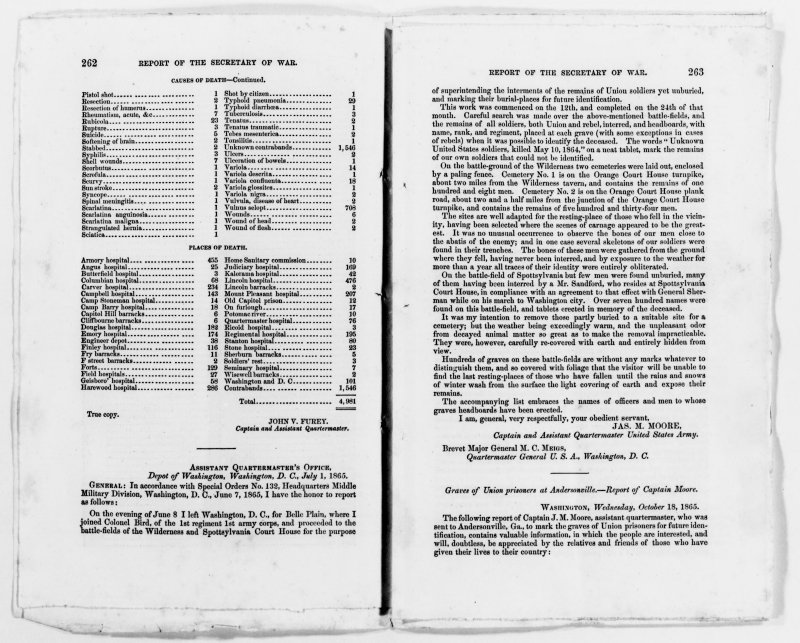
262
REPORT OF THE SECRETARY OF WAR.
CAUSES OF DEATH—Continued.
| Pistol shot | 1 | Shot by citizen | 1 |
| Resection | 2 | Typhoid pneumonia | 29 |
| Resection of humerus | 1 | Typhoid diarrhœa | 1 |
| Rheumatism, acute, &c. | 7 | Tuberculosis | 3 |
| Rubicola | 23 | Tenatus | 2 |
| Rupture | 3 | Tenatus traumatic | 1 |
| Suicide | 5 | Tebes mesenterica | 2 |
| Softening of brain | 2 | Tonsilitis | 1 |
| Stabbed | 2 | Unknown contrabands | 1,546 |
| Syphilis | 3 | Ulcers | 2 |
| Shell wounds | 7 | Ulceration of bowels | 1 |
| Scorbutus | 1 | Variola | 14 |
| Scrofula | 1 | Variola descrita | 1 |
| Scurvy | 1 | Variola confluenta | 18 |
| Sun stroke | 2 | Variola glossites | 1 |
| Syncope | 1 | Variola nigra | 2 |
| Spinal meningitis | 1 | Vulvula, disease of heart | 2 |
| Scarlatina | 1 | Vulnus selopt | 708 |
| Scarlatina anguinosa | 1 | Wounds | 6 |
| Scarlatina maligna | 1 | Wound of head | 2 |
| Strangulated hernia | 1 | Wound of flesh | 2 |
| Sciatica | 1 |
PLACES OF DEATH.
| Armory hospital | 455 | Home Sanitary commission | 10 |
| Angus hospital | 25 | Judiciary hospital | 169 |
| Butterfield hospital | 3 | Kalorama hospital | 42 |
| Columbian hospital | 68 | Lincoln hospital | 476 |
| Carver hospital | 234 | Lincoln barracks | 2 |
| Campbell hospital | 143 | Mount Pleasant hospital | 207 |
| Camp Stoneman hospital | 14 | Old Capitol prison | 12 |
| Camp Barry hospital | 18 | On furlough | 17 |
| Capitol Hill barracks | 6 | Potomac river | 10 |
| Cliffbourne barracks | 6 | Quartermaster hospital | 76 |
| Douglas hospital | 182 | Ricoid hospital | 3 |
| Emory hospital | 174 | Regimental hospital | 195 |
| Engineer depot | 38 | Stanton hospital | 80 |
| Finley hospital | 116 | Stone hospital | 23 |
| Fry barracks | 11 | Sherburn barracks | 5 |
| F street barracks | 2 | Soldiers' rest | 3 |
| Forts | 129 | Seminary hospital | 7 |
| Field hospitals | 27 | Wisewell barracks | 2 |
| Geisboro' hospital | 58 | Washington and D. C. | 101 |
| Harewood hospital | 286 | Contrabands | 1,546 |
| Total | 4,981 | ||
True copy.
JOHN V. FUREY.Captain and Assistant Quartermaster.ASSISTANT QUARTERMASTER'S OFFICE,
Depot of Washington, Washington, D. C., July 1, 1865.
GENERAL: In accordance with Special Orders No. 132, Headquarters Middle Military Division, Washington, D. C., June 7, 1865, I have the honor to report as follows:
On the evening of June 8 I left Washington, D. C., for Belle Plain, where I joined Colonel Bird, of the 1st regiment 1st army corps, and proceeded to the battle-fields of the Wilderness and Spottsylvania Court House for the purpose
REPORT OF THE SECRETARY OF WAR.
263
of superintending the interments of the remains of Union soldiers yet unburied, and marking their burial-places for future identification.
This work was commenced on the 12th, and completed on the 24th of that month. Careful search was made over the above-mentioned battle-fields, and the remains of all soldiers, both Union and rebel, interred, and headboards, with name, rank, and regiment, placed at each grave (with some exceptions in cases of rebels) when it was possible to identify the deceased. The words "Unknown United States soldiers, killed May 10, 1864," on a neat tablet, mark the remains of our own soldiers that could not be identified.
On the battle-ground of the Wilderness two cemeteries were laid out, enclosed by a paling fence. Cemetery No. 1 is on the Orange Court House turnpike, about two miles from the Wilderness tavern, and contains the remains of one hundred and eight men. Cemetery No. 2 is on the Orange Court House plank road, about two and a half miles from the junction of the Orange Court House turnpike, and contains the remains of five hundred and thirty-four men.
The sites are well adapted for the resting-place of those who fell in the vicinity, having been selected where the scenes of carnage appeared to be the greatest. It was no unusual occurrence to observe the bones of our men close to the abatis of the enemy; and in one case several skeletons of our soldiers were found in their trenches. The bones of these men were gathered from the ground where they fell, having never been interred, and by exposure to the weather for more than a year all traces of their identity were entirely obliterated.
On the battle-field of Spottsylvania but few men were found unburied, many of them having been interred by a Mr. Sandford, who resides at Spottsylvania Court House, in compliance with an agreement to that effect with General Sherman while on his march to Washington city. Over seven hundred names were found on this battle-field, and tablets erected in memory of the deceased.
It was my intention to remove those partly buried to a suitable site for a cemetery; but the weather being exceedingly warm, and the unpleasant odor from decayed animal matter so great as to make the removal impracticable. They were, however, carefully re-covered with earth and entirely hidden from view.
Hundreds of graves on these battle-fields are without any marks whatever to distinguish them, and so covered with foliage that the visitor will be unable to find the last resting-places of those who have fallen until the rains and snows of winter wash from the surface the light covering of earth and expose their remains.
The accompanying list embraces the names of officers and men to whose graves headboards have been erected.
I am, general, very respectfully, your obedient servant,JAS. M. MOORE,
Captain and Assistant Quartermaster United States Army.Brevet Major General M. C. MEIGS,
Quartermaster General U. S. A., Washington, D. C. Graves of Union prisoners at Andersonville.—Report of Captain Moore.
WASHINGTON, Wednesday, October 18, 1865.
The following report of Captain J. M. Moore, assistant quartermaster, who was sent to Andersonville, Ga., to mark the graves of Union prisoners for future identification, contains valuable information, in which the people are interested, and will, doubtless, be appreciated by the relatives and friends of those who have given their lives to their country: