 Talk to Sales
 Benchmarks
View scores and output across OCR models spanning many document categories.
Want to run these evals on your own documents?
Talk to Sales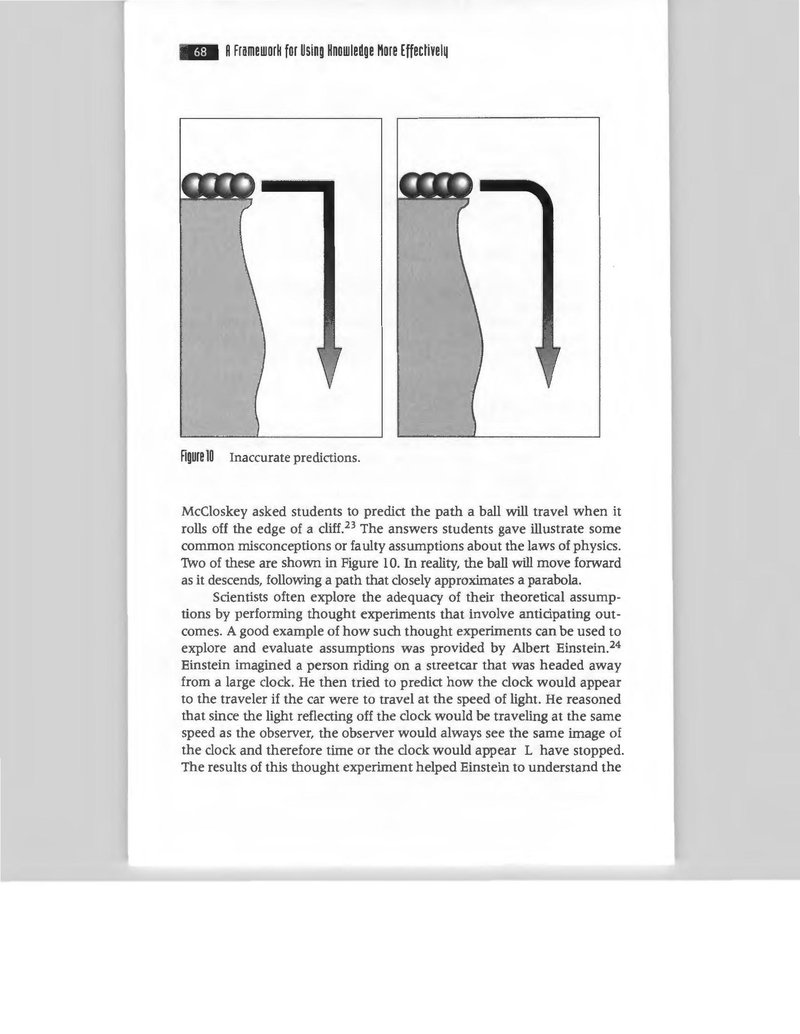
68
A Framework for Using Knowledge More Effectively

Figure 10 Inaccurate predictions.
McCloskey asked students to predict the path a ball will travel when it rolls off the edge of a cliff. 23 The answers students gave illustrate some common misconceptions or faulty assumptions about the laws of physics. Two of these are shown in Figure 10. In reality, the ball will move forward as it descends, following a path that closely approximates a parabola.
Scientists often explore the adequacy of their theoretical assumptions by performing thought experiments that involve anticipating outcomes. A good example of how such thought experiments can be used to explore and evaluate assumptions was provided by Albert Einstein. 24 Einstein imagined a person riding on a streetcar that was headed away from a large clock. He then tried to predict how the clock would appear to the traveler if the car were to travel at the speed of light. He reasoned that since the light reflecting off the clock would be traveling at the same speed as the observer, the observer would always see the same image of the clock and therefore time or the clock would appear L have stopped. The results of this thought experiment helped Einstein to understand the