 Talk to Sales
 Benchmarks
View scores and output across OCR models spanning many document categories.
Want to run these evals on your own documents?
Talk to Sales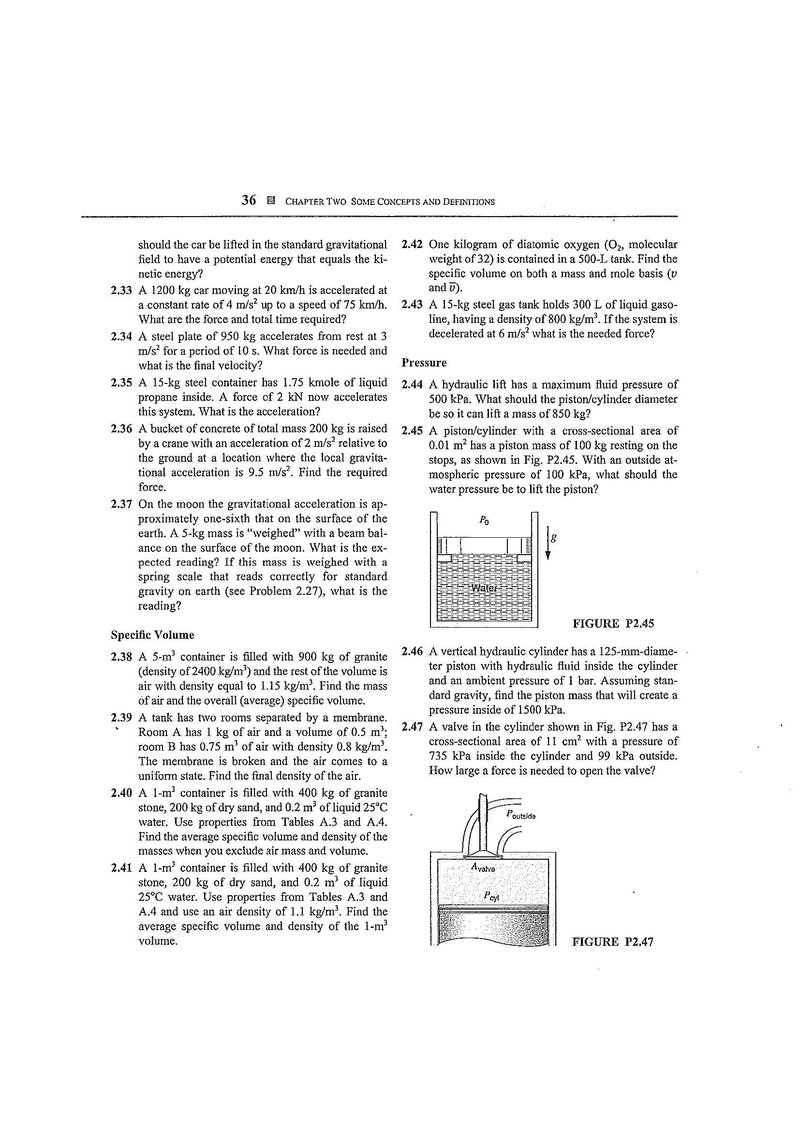
36 CHAPTER TWO SOME CONCEPTS AND DEFINITIONS
should the car be lifted in the standard gravitational field to have a potential energy that equals the kinetic energy?
2.33 A 1200 kg car moving at 20 km/h is accelerated at a constant rate of up to a speed of 75 km/h. What are the force and total time required?
2.34 A steel plate of 950 kg accelerates from rest at for a period of 10 s. What force is needed and what is the final velocity?
2.35 A 15-kg steel container has 1.75 kmole of liquid propane inside. A force of 2 kN now accelerates this system. What is the acceleration?
2.36 A bucket of concrete of total mass 200 kg is raised by a crane with an acceleration of relative to the ground at a location where the local gravitational acceleration is . Find the required force.
2.37 On the moon the gravitational acceleration is approximately one-sixth that on the surface of the earth. A 5-kg mass is ‘‘weighed’’ with a beam balance on the surface of the moon. What is the expected reading? If this mass is weighed with a spring scale that reads correctly for standard gravity on earth (see Problem 2.27), what is the reading?
Specific Volume
2.38 A container is filled with 900 kg of granite (density of ) and the rest of the volume is air with density equal to . Find the mass of air and the overall (average) specific volume.
2.39 A tank has two rooms separated by a membrane. Room A has 1 kg of air and a volume of ; room B has of air with density . The membrane is broken and the air comes to a uniform state. Find the final density of the air.
2.40 A container is filled with 400 kg of granite stone, 200 kg of dry sand, and of liquid water. Use properties from Tables A.3 and A.4. Find the average specific volume and density of the masses when you exclude air mass and volume.
2.41 A container is filled with 400 kg of granite stone, 200 kg of dry sand, and of liquid water. Use properties from Tables A.3 and A.4 and use an air density of . Find the average specific volume and density of the volume.
2.42 One kilogram of diatomic oxygen ( , molecular weight of 32) is contained in a 500-L tank. Find the specific volume on both a mass and mole basis ( and ).
2.43 A 15-kg steel gas tank holds 300 L of liquid gasoline, having a density of . If the system is decelerated at what is the needed force?
Pressure
2.44 A hydraulic lift has a maximum fluid pressure of 500 kPa. What should the piston/cylinder diameter be so it can lift a mass of 850 kg?
2.45 A piston/cylinder with a cross-sectional area of has a piston mass of 100 kg resting on the stops, as shown in Fig. P2.45. With an outside atmospheric pressure of 100 kPa, what should the water pressure be to lift the piston?

FIGURE P2.45
2.46 A vertical hydraulic cylinder has a 125-mm-diameter piston with hydraulic fluid inside the cylinder and an ambient pressure of 1 bar. Assuming standard gravity, find the piston mass that will create a pressure inside of 1500 kPa.
2.47 A valve in the cylinder shown in Fig. P2.47 has a cross-sectional area of with a pressure of 735 kPa inside the cylinder and 99 kPa outside. How large a force is needed to open the valve?

FIGURE P2.47